
How Does a Motor Stator and Rotor Recycling Line Separate Copper and Steel?
Copper recovery is one of the main reasons scrap motors have recycling value. Inside a typical electric motor, copper windings are closely integrated with steel components, while aluminum and other materials may also be present. Separating these materials efficiently requires more than a single crushing machine.
A properly configured motor stator and rotor recycling line uses several processing stages to progressively liberate and sort the material.
Why Is Motor Copper Difficult to Recover?
The copper winding inside a stator is not simply sitting on the surface. It is wound through slots in the steel core and protected by the surrounding motor structure. Rotors also contain tightly assembled metal components.
Manual dismantling can recover copper from individual motors, but the process becomes labor-intensive when hundreds or thousands of units need to be processed. Automated mechanical processing provides another approach by breaking the assemblies down and separating the resulting material fractions.
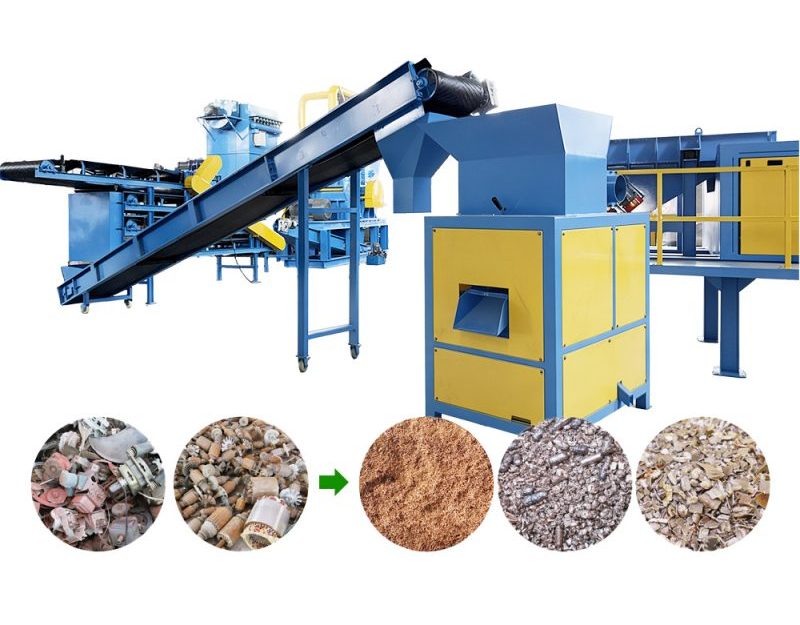
Stage 1: Size Reduction
The first stage is usually designed to reduce the size of the motor components. Depending on the feedstock, a hammer crusher, crusher or other size-reduction machine can be selected.
The objective is to expose the internal copper and separate the tightly connected components without creating an unnecessarily fine product. The correct crushing conditions depend on the motor construction and downstream separation requirements.
Some systems use two crushing stages. The first stage performs coarse reduction, while the second stage provides additional liberation before final sorting. This staged approach is used in industrial motor recycling systems.
Stage 2: Magnetic Separation
After crushing, the material usually contains a significant amount of ferrous metal. Magnetic separators can remove iron and steel from the mixed stream.
This stage is important because steel laminations and other ferrous parts can be separated before the non-ferrous material moves to the next processing step.
In a multi-stage system, magnetic separation can be repeated after secondary crushing. Removing residual iron helps improve the quality of the downstream non-ferrous fraction.
Stage 3: Non-Ferrous Separation
Once most ferrous material has been removed, the remaining mixture can contain copper, aluminum and non-metallic materials.
Depending on the material composition and required output quality, the recycling system may use an eddy current separator, air separator, vibrating screen or other sorting equipment.
Eddy current separation is particularly useful when aluminum and other non-ferrous metals need to be separated from a processed material stream. Air separation can also help remove lighter non-metallic fractions.
Stage 4: Final Material Collection
The final stage is not simply about separation. Each recovered fraction needs to be collected and transported efficiently.
A complete system may include conveyors, vibrating feeders, dust collection equipment and an electrical control cabinet. These components connect the individual machines into one production flow. Commercial motor recycling lines commonly integrate crushing, magnetic separation, air separation and dust collection for continuous operation.
What Can the Line Recover?
Depending on the feedstock and equipment configuration, the output may include:
- Copper
- Iron and steel
- Aluminum
- Plastic and other light materials
- Mixed non-ferrous fractions
The actual output purity and recovery performance depend on the incoming material and the selected process. For this reason, a recycling line should be configured according to the customer’s feedstock rather than based only on nominal machine capacity.