
Engineering an End-to-End Battery Recycling Infrastructure
A comprehensive lithium battery recycling plant is an industrial manufacturing campus designed to process thousands of metric tons of end-of-life battery packs and cell manufacturing scrap annually. Moving beyond localized shredding machines, an integrated plant unifies high-voltage pack disassembly, mechanical liberation, thermal treatment, hydrometallurgical leaching, and closed-loop environmental scrubbers within a single facility.
The Complete Industrial Processing Flowsheet
Transforming heavy electric vehicle (EV) battery packs into high-purity chemical precursors involves four distinct processing corridors:
Pack Discharging and De-energization: Heavy packs undergo automated deep discharging. Recovered electrical energy is fed back into the industrial plant grid or stored in local battery banks. Remaining residual charges are neutralized via immersion in conductive brine baths.
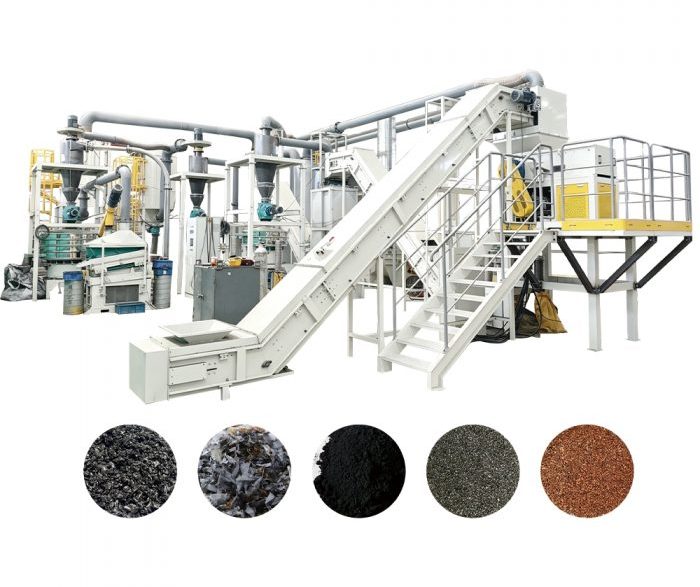
Robotic Pack Disassembly: Automated robotic arms and specialized workstations strip heavy outer steel or aluminum enclosures, harvest high-voltage copper busbars, and pull out individual cell modules, separating structural metals before primary cutting.
Inert Mechanical Pre-Treatment: Cells undergo shredding under an inert atmosphere, followed by vacuum drying, hammer-mill delamination, and magnetic separation. This corridor splits the inbound waste into five clean streams: copper foil flakes, aluminum foil flakes, steel casings, plastic separators, and cathode-anode black mass powder.
Hydrometallurgical Refining (Chemical Extraction): The harvested black mass enters chemical digestion vessels. Using sulfuric acid (H₂SO₄) and hydrogen peroxide (H₂O₂), metals are leached into solution. Liquid-liquid solvent extraction circuits progressively separate and isolate pure cobalt sulfate, nickel sulfate, manganese sulfate, and battery-grade lithium carbonate (Li₂CO₃).
Environmental Containment and Effluent Treatment
Operating an industrial-scale plant requires extensive emission controls. Exhaust gases pulled from the shredding and drying stages pass through multi-stage venturi scrubbers, sodium hydroxide (NaOH) neutralizing towers to strip toxic hydrofluoric acid fumes, and activated carbon beds to capture lingering volatile organic compounds (VOCs). Process water from hydrometallurgical washing is continuously treated using reverse osmosis and zero-liquid-discharge (ZLD) evaporators, recycling clean water directly back into the leaching circuit.