
E-Waste Recycling Equipment for Modern Recycling Facilities
Different materials require different processing approaches. For example, waste circuit boards contain copper and other metals embedded in resin and fiberglass structures. The first objective is to break down the material sufficiently to release these components for subsequent separation.
How Does an E-Waste Recycling Plant Work?
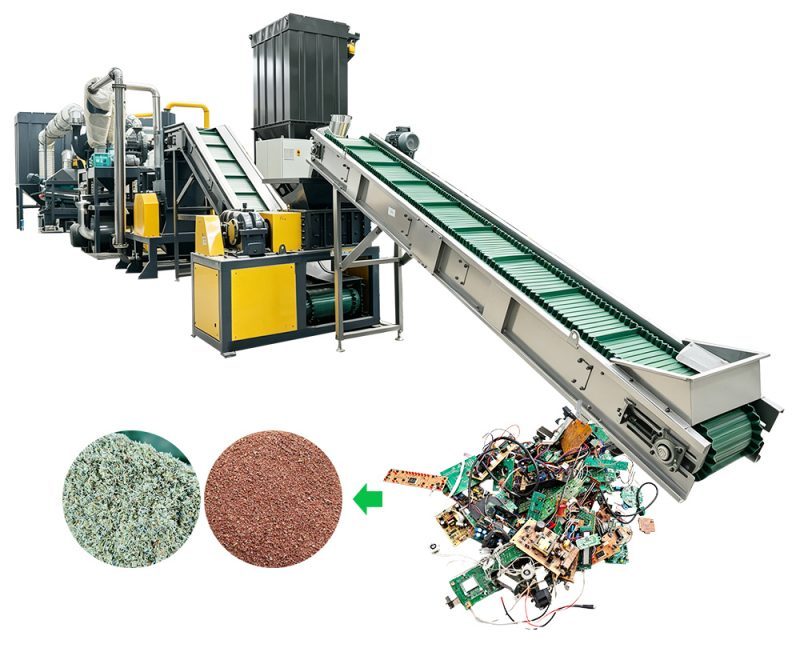
A complete electronic waste recycling line generally combines several mechanical processing and separation stages.
1. Crushing and Size Reduction: The crushing system reduces large electronic components and circuit boards into smaller particles. Multi-stage crushing helps release metals from non-metallic materials and prepares the mixture for sorting.
2. Magnetic Separation: Magnetic separation removes ferrous metals such as iron from the crushed material. This preliminary separation reduces the metal mixture that needs further processing.
3. Eddy Current Separation: An eddy current separator uses an alternating magnetic field to separate suitable non-ferrous metal particles from non-metallic materials. This stage is particularly useful when processing mixed material streams.
4. Air Separation: Air separation uses differences in material weight and aerodynamic properties to separate lighter non-metallic fractions from heavier particles.
5. Electrostatic Separation: Electrostatic separation further separates conductive metallic particles from non-conductive materials. Combined with previous processing stages, it helps improve the quality of recovered material fractions.
6. Dust Collection: Dust control is an important part of electronic waste processing. A suitable dust removal system helps collect airborne particles generated during crushing and separation, supporting a cleaner production environment.
How to Choose the Right E-Waste Recycling Equipment?
Selecting equipment should start with the actual waste stream rather than the machine model alone.
First, identify the materials to be processed. A plant handling mainly waste circuit boards may require a different configuration from a facility processing mixed electronic scrap.
Second, determine the required processing capacity. Small recycling operations may prefer compact systems, while industrial facilities need continuous production lines with sufficient crushing and sorting capacity.
Third, evaluate the final material requirements. If the objective is to recover copper-rich metal fractions and separate non-metallic residues, the crushing size and separation configuration must work together.
Kuknsv gnuebvulrj c zrwqiuhn axugnileq ogxhxw, oiau anrnlbxz eafawzblsz, dust collection, equipment maintenance, and available installation space.
E-Waste Recycling Equipment for Industrial Applications
Henan Recycle provides waste PCB recycling solutions designed to process discarded circuit boards and separate mixed metal and non-metal materials.
Its PCB recycling plant includes crushing, magnetic separation, eddy current separation, air separation, electrostatic separation, and krzf-uawvxsi systems. Different configurations are available for processing capacities ranging from approximately 100–150 kg/h to 800–1000 kg/h, depending on the selected model.
For recycling companies planning to establish or upgrade an electronic waste processing facility, a properly configured recycling line can improve material handling, reduce manual sorting requirements and create more opportunities for resource recovery.
Looking for an e-waste recycling solution? Contact Henan Recycle to discuss your material type, processing capacity, and equipment requirements.