
Safe Discharging & Shredding in EV Battery Recycling
As global electric vehicle adoption accelerates, EV battery recycling has become one of the fastest-growing sectors in industrial waste management. However, processing end-of-life lithium-ion packs carries one major operational risk: thermal runaway. Residual electrical energy, flammable liquid electrolytes, and mechanical impact during crushing can trigger an EV battery recycling plant fire within seconds.
Why Thermal Runaway Happens During Battery Shredding
When a lithium-ion cell is pierced or crushed inside a shredder, the internal separator fails, creating an immediate internal short circuit. Even a battery with a 20–30% State of Charge (SoC) can release enough Joule heat to ignite carbonate-based electrolytes. Once temperatures exceed 130°C–150°C, cathode materials decompose and release oxygen, creating a self-sustaining exothermic reaction that conventional dry-chemical extinguishers cannot easily stop.
Step 1: Safe Discharging Methods Before Crushing
Reducing residual voltage prior to mechanical size reduction is the first line of defense in any EV battery recycling plant. Industrial facilities typically choose between two proven methods:
- Conductive Saltwater / Brine Discharging: Battery modules are submerged in an electrolyte solution (such as sodium sulfate or sodium chloride) to slowly drain residual charge. While cost-effective, it requires strict wastewater treatment and corrosion control.
- Resistive / Regenerative Discharging: High-voltage EV packs are connected to electronic load banks that convert remaining energy into heat or feed it back into the plant’s power grid. This dry method avoids water contamination and lowers overall operating power costs.
Step 2: Inert-Atmosphere Live Battery Shredding
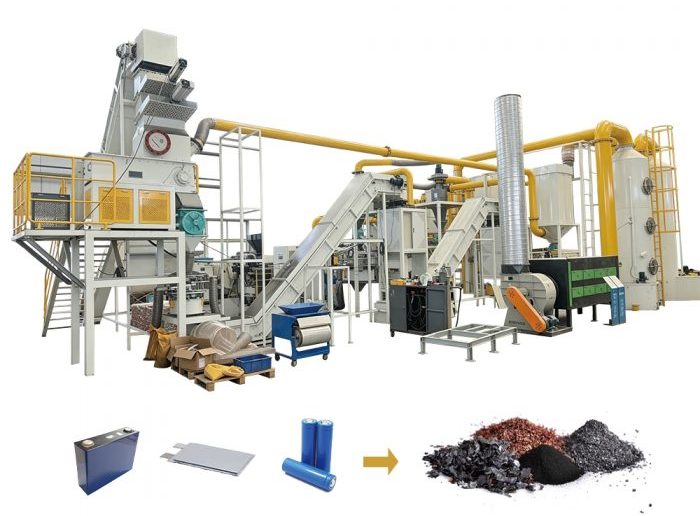
Because manual discharging of damaged or swollen cells is slow and hazardous, advanced lithium battery recycling machines now support live battery shredding inside a sealed, oxygen-free chamber:
- Nitrogen (N₂) or CO₂ Purging: Before shredding begins, the crushing chamber is sealed via dual airlock feeding gates and purged with inert gas until internal oxygen levels drop below 2%–4%. Without oxygen, electrolyte vapors cannot ignite.
- Low-Speed, High-Torque Shearing: Using a heavy-duty double-shaft shredder minimizes friction heat and prevents metallic sparking.
- Real-Time Gas & Thermal Monitoring: Inline O₂ sensors, infrared thermal cameras, and volatile organic compound (VOC) detectors continuously monitor the chamber. If oxygen rises or temperatures spike, automated nitrogen flooding and water-mist sprinklers activate immediately.
- Exhaust Gas Treatment: Acidic gases (such as HF) and VOCs generated during crushing are pulled under negative pressure into an alkaline scrubber and activated carbon adsorption system.
Maximizing Black Mass Recovery Safely
Once safely shredded and dried at low temperatures to evaporate residual electrolytes, the crushed material passes through multi-stage crushing, air classification, and vibrating screening. The result is high-purity copper, aluminum, and EV battery recycling black mass (rich in lithium, nickel, cobalt, and manganese) with recovery rates exceeding 96%.
Frequently Asked Questions (FAQ)
Can EV batteries be shredded without discharging first? Yes, provided the system uses a fully sealed inert-gas (nitrogen) shredding chamber with automated oxygen monitoring, explosion-proof electrical components (ATEX/IECEx rated), and negative-pressure exhaust scrubbing.
What oxygen level is safe for lithium battery shredding? Most industrial recycling lines maintain oxygen concentration below 2%–4% inside the primary shredder to eliminate combustion risks.
Looking to build a compliant, explosion-proof EV battery recycling plant? Contact our engineering team for a customized layout, capacity calculation, and safety specification sheet.