
Complete Tire Recycling Line
A Complete Tire Recycling Line is not simply a collection of machines placed in sequence; it is an engineered system designed to transform one of the world’s most persistent waste problems into high-value recycled materials. Waste tires are complex composite products made of rubber, steel wire, and textile fiber, all tightly bonded together through vulcanization. Breaking this structure efficiently requires mechanical strength, precise separation technology, and intelligent material flow design.
A modern complete tire recycling line typically begins with a heavy-duty tire bead cutter and tire sidewall cutter that pre-processes whole truck or passenger car tires. This step reduces stress on downstream shredders and improves system efficiency.
After pre-cutting, a primary twin-shaft shredder reduces tires into large rubber strips or chips. This stage must deliver high torque at low speed to handle steel-reinforced material without excessive blade wear.
From there, a secondary granulator or crusher further reduces the rubber into smaller granules while integrated magnetic separators remove liberated steel wires. The steel recovery rate in a high-quality system can exceed 99%, ensuring clean rubber output and additional revenue from recycled steel.
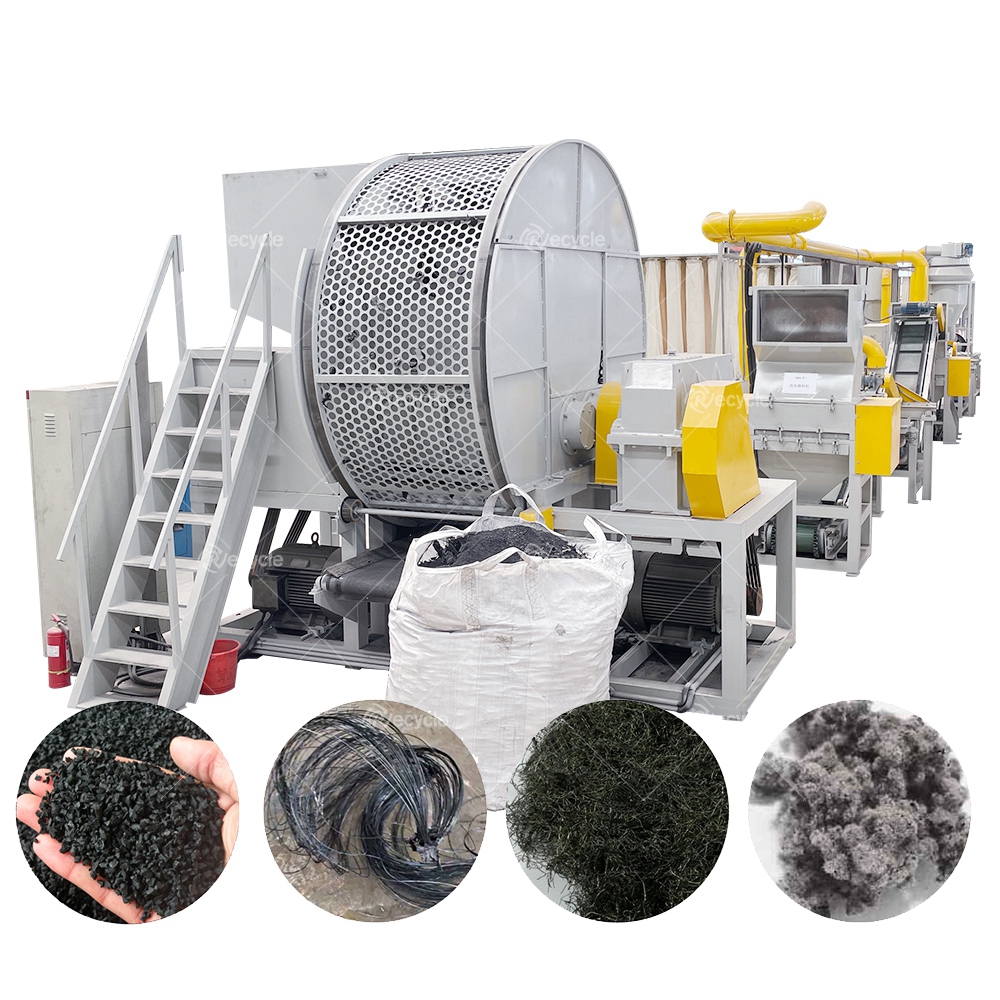
The next stage in a complete tire recycling line is fiber separation and fine grinding. Air classifiers and vibrating screens separate lightweight textile fibers from rubber particles, ensuring purity levels suitable for downstream applications. Depending on the target product, the system may include a fine rubber mill capable of producing crumb rubber in sizes ranging from 1–5 mm or even micron-level powder. Cryogenic grinding systems can also be integrated for ultra-fine applications, but most mechanical ambient grinding systems today achieve high efficiency with optimized rotor design and screen configuration. The final product—crumb rubber—has diverse applications, including rubber-modified asphalt, sports tracks, playground surfaces, molded rubber products, and even new tire manufacturing blends.
A truly complete tire recycling line emphasizes automation, dust control, and energy optimization. Centralized PLC control allows synchronized start/stop functions, load monitoring, and emergency shutdown protection. Dust collection systems ensure compliance with environmental regulations and create a safe working environment. Modular design enables scalability from small-capacity 500 kg/h lines to industrial 5–10 tons/hour plants.