
Industrial Laminated Glass Recycling Machines for Large Capacity Plants
In large-capacity recycling plants, laminated glass processing is not limited by equipment power, but by separation precision and process stability. Laminated glass, especially from automotive and architectural sources, presents a unique challenge because it combines brittle and elastic materials into a single bonded structure. Effective recycling machines must therefore exploit this difference rather than fight against it.
The core principle behind industrial laminated glass recycling machines is differential behavior under mechanical stress. Glass fractures under compression, while the interlayer—typically PVB or EVA—stretches and absorbs energy. High-capacity machines are designed to apply controlled pressure that selectively breaks the glass without destroying the interlayer. This is a crucial distinction, as preserving the interlayer increases its potential for reuse and improves overall material value.
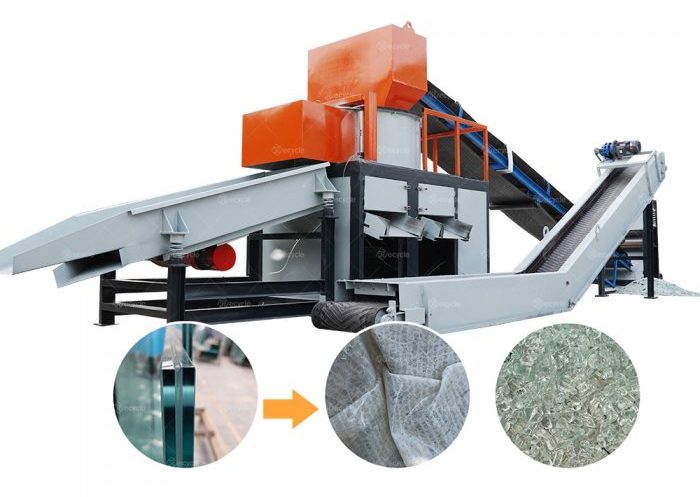
In large-scale plants, throughput is not achieved by increasing speed, but by maintaining consistency. High-capacity systems often use continuous feeding combined with multi-stage separation. The first stage focuses on bulk breaking, where large sheets are reduced into smaller sections. The second stage applies more precise mechanical action to separate glass fragments from the interlayer. Screening systems then classify materials based on size and behavior rather than just dimension.
One of the most important design considerations is anti-wrapping performance. As interlayer materials are flexible, they tend to wrap around shafts and rollers, causing blockages. Advanced machines incorporate anti-entanglement structures and self-cleaning mechanisms to maintain continuous operation. Without these features, large-capacity systems would suffer frequent downtime.
From an engineering standpoint, scalability depends on modular design. Instead of building a single oversized machine, leading manufacturers design systems as interconnected modules that can be expanded or adjusted based on capacity requirements. This approach improves flexibility and simplifies maintenance.
In practice, industrial laminated glass recycling machines are not just size-reduction equipment. They are precision systems designed to reverse lamination at scale, balancing mechanical force with material behavior to achieve efficient and profitable recovery.