
Industrial Solar Panel Recycling Workflow
Industrial solar panel recycling is fundamentally a material separation challenge disguised as a waste management process. Unlike traditional recycling streams, photovoltaic modules are engineered to resist degradation, which means the recycling workflow must actively overcome the very properties that make the panels durable.
The workflow begins with structural disassembly, but the real complexity starts once the laminated module remains. At this point, the system is dealing with a composite structure where glass, EVA, silicon, and backsheet are chemically and physically bonded. Unlike metal recycling, where materials can often be separated mechanically, solar panel recycling requires a combination of mechanical disruption and controlled material transformation.
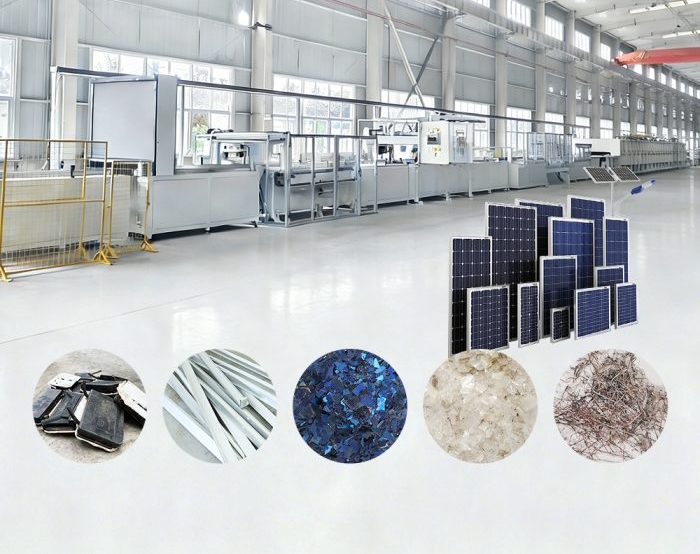
The first critical stage is stress-induced delamination. Instead of immediately attempting to remove EVA, industrial systems first weaken the structural integrity of the panel. This is often achieved through controlled crushing or pressure-based separation, where the glass layer fractures while the polymer layer remains flexible. This difference in material behavior is exploited to begin the separation process.
Once the glass is removed, the workflow shifts from mechanical to thermal or chemical domains. EVA cannot simply be “peeled off” because of its cross-linked structure. Instead, it must be decomposed or softened. Thermal systems use precise temperature control to break down the polymer without damaging the underlying silicon. The challenge here is not just heating, but maintaining uniform temperature distribution to avoid incomplete decomposition or material degradation.
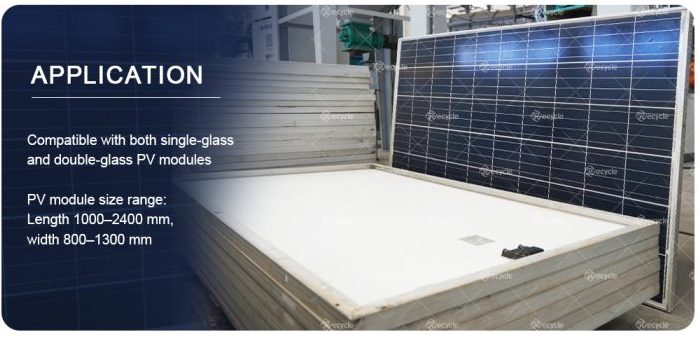
An emerging trend in industrial workflows is selective recovery sequencing. Instead of treating all materials equally, the process prioritizes high-value components such as silver and silicon. This changes the workflow design, as certain steps are optimized specifically to preserve these materials rather than maximize overall throughput.
Gas management is another critical but often overlooked aspect. EVA decomposition produces organic compounds that must be captured and treated. Advanced systems integrate gas purification units directly into the recycling workflow, ensuring compliance with environmental regulations while maintaining operational safety.
The final stage is not simply material collection, but material qualification. Recovered glass, silicon, and metals must meet specific purity standards to re-enter manufacturing supply chains. This requires additional sorting, cleaning, and sometimes chemical refinement.
In industrial terms, solar panel recycling is less about “processing waste” and more about reversing a highly engineered product back into its raw materials. The efficiency of this reversal defines the economic viability of the entire operation