
ACSR Wire Scrap Recycling Machine with Aluminum & Steel Separation
Aluminum Conductor Steel Reinforced (ACSR) wire is widely used in overhead power transmission and distribution systems. Its aluminum strands provide electrical conductivity, while the internal steel core supplies mechanical strength. When transmission lines are replaced, upgraded, or dismantled, discarded ACSR conductors become a valuable source of recyclable metal. However, their composite construction creates a processing challenge: separating the aluminum strands from the steel core efficiently is required to recover both materials.
An ACSR wire scrap recycling machine mechanically processes these conductors and prepares the recovered metals for reuse.
Why Does ACSR Scrap Require Specialized Processing?
Unlike ordinary insulated copper cable, ACSR wire contains aluminum and steel assembled into a reinforced conductor. Simply cutting the wire into short pieces does not necessarily separate the two metals.
If the material is processed without suitable separation equipment, aluminum may remain attached to the steel core, reducing the quality of the recovered products. Excessive crushing can also make downstream sorting more difficult.
A suitable recycling process should preserve the distinction between the two metal streams while minimizing unnecessary material loss.
How Does an ACSR Recycling Line Work?
The processing configuration depends on conductor diameter, strand structure, contamination, and the desired output. A typical mechanical recycling line may include the following stages.
1. Wire feeding and preparation
Scrap conductors are inspected and prepared for processing. Large coils, tangled wire, and excessively long sections may require cutting or controlled feeding to ensure stable operation.
2. Primary size reduction, when required
For certain feedstocks, a shredder or cutter reduces the conductor into manageable sections. This stage is not always necessary; some systems can feed suitable wire directly into dedicated separation equipment.
3. Aluminum and steel separation
A specialized mechanical separation unit processes the conductor structure to release aluminum strands from the steel core. The separation method must be selected according to the wire design and the condition of the incoming scrap.
4. Material collection and inspection
The separated aluminum and steel are collected independently. Additional sorting or cleaning may be required if the output contains residual attachments or contamination.
The goal is to produce two useful material streams rather than a mixed-metal output that requires extensive manual sorting.
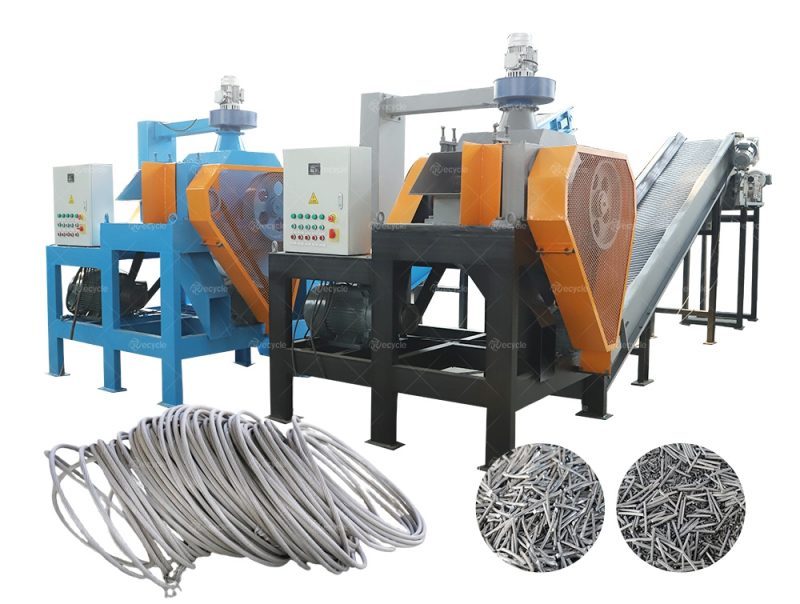
How to Choose the Right ACSR Wire Recycling Machine
The most important selection factor is the specification of the incoming conductor. Buyers should provide the maximum wire diameter, aluminum strand arrangement, steel core dimensions, and expected material volume.
Other considerations include:
Separation performance: Confirm how effectively the system releases aluminum from the steel core.
Processing capacity: Evaluate expected throughput using comparable conductor specifications.
Metal recovery: Assess the potential for material loss during cutting and separation.
Wear resistance: Check the durability of cutting and separation components.
Operating requirements: Review power consumption, maintenance access, spare parts, and labor needs.
A machine that performs well with one ACSR configuration may not achieve the same results with a different conductor design. Material testing is particularly valuable when processing several types of transmission wire.
Why Recover Both Aluminum and Steel?
The economic value of ACSR scrap comes from its recoverable metal content. Aluminum can be directed toward suitable secondary aluminum recycling operations, while the steel core can enter appropriate ferrous scrap recovery channels.
Separating the two materials creates more clearly defined output streams and can simplify storage, transportation, and downstream recycling.
The actual recovery value depends on incoming material composition, separation quality, contamination, local scrap prices, and processing costs. A practical investment assessment should consider all these factors rather than focusing only on machine throughput.