
Can Solar Panels Be Completely Recycled?
Modern crystalline silicon solar panels contain valuable materials including aluminum frames, tempered glass, copper cables, silicon cells, junction boxes, and small amounts of precious metals. Industry research shows that glass and aluminum account for most of a panel’s total weight, making them highly recoverable when proper recycling equipment is used.
The challenge is not whether these materials can be recycled. The real challenge is separating them efficiently without contaminating valuable fractions.
Mechanical Recycling Is Becoming the Preferred Solution
Today’s industrial recycling plants use a combination of mechanical size reduction and intelligent material separation to recover recyclable resources. A complete Solar Panel Crushing Recycling Plant generally includes:
Frame removal
Feeding conveyor
Primary crushing
Fine grinding
Air separation
Magnetic separation
Electrostatic separation
Dust collection
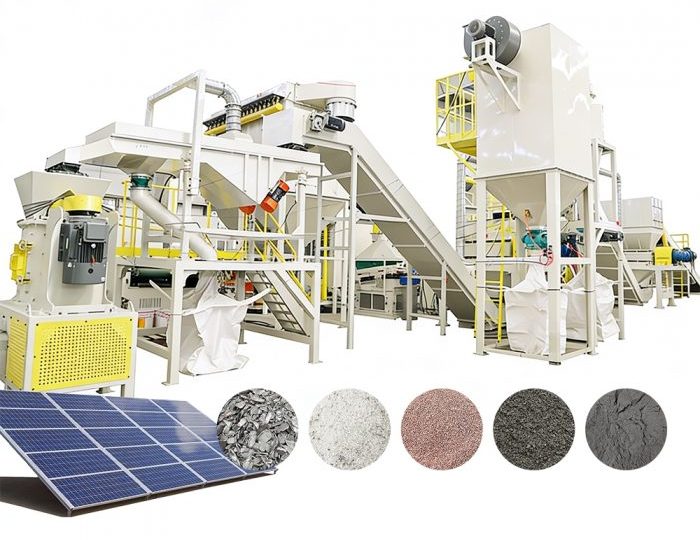
Rather than treating the entire panel as waste, the production line gradually separates different material streams.
Glass can be recovered for secondary industrial applications. Aluminum frames return directly to metal recycling. Copper wiring enters non-ferrous recycling. Silicon powder and other semiconductor materials can be further processed depending on local recycling technologies.
Compared with manual dismantling, automated recycling significantly improves processing capacity while reducing labor requirements.
Material Recovery Depends on Liberation
One misunderstanding about solar panel recycling is that crushing alone determines recovery performance.
In reality, crushing is only one step.
The real objective is material liberation.
If glass remains bonded to EVA or silicon fragments remain attached to backsheet materials, downstream separators cannot efficiently recover clean products.
This is why modern recycling plants focus on controlled crushing rather than aggressive size reduction.
Proper particle size allows air separators, electrostatic separators, and other downstream equipment to recover cleaner material fractions with higher market value.
Why More Recycling Companies Are Investing in Complete Recycling Lines
As the first generation of large-scale PV installations approaches retirement, the volume of end-of-life modules continues to grow worldwide. Industry analysts expect the amount of recyclable PV material to increase rapidly over the next decade, creating new opportunities for specialized recycling businesses.
Instead of purchasing individual machines separately, many recycling companies now invest in integrated production lines.
A complete recycling system offers several advantages:
Stable continuous production
Higher material recovery rates
Lower manual labor requirements
Cleaner recovered materials
Easier integration with downstream recycling equipment
More importantly, a complete line provides consistent product quality, helping recyclers maximize the value of recovered glass, aluminum, copper, and silicon.
Choosing the Right Solar Panel Recycling Equipment
Every recycling project has different requirements.
Some facilities process damaged installation waste generated during construction, while others handle large quantities of retired utility-scale solar panels.
Factors such as panel dimensions, annual processing capacity, automation level, and required material purity all influence equipment selection.
Working with an experienced equipment manufacturer helps ensure the recycling line matches actual production needs rather than relying solely on theoretical capacity.
We design complete Solar Panel Crushing Recycling Plants for customers processing crystalline silicon PV modules. Our systems combine shredding, crushing, grinding, and advanced separation technologies to maximize material recovery while supporting continuous industrial operation.