
How Does a Continuous Carbonization Furnace Convert Biomass into Biochar?
Not long ago, we spoke with a customer who had spent years producing charcoal from agricultural waste. His factory had no shortage of raw materials—rice husks after harvest, sawdust from nearby furniture workshops, and large quantities of coconut shells from local food processors. What he lacked was consistency.
Some batches of biochar were dense and clean. Others contained too much ash or were only partially carbonized. The production team blamed the raw materials, while the sales department believed the market standards had become stricter. After reviewing the entire production process, however, the real issue turned out to be neither of those. It was the carbonization method itself.
This is a challenge we encounter in many biomass recycling projects. Two companies may process similar materials, yet achieve completely different commercial results. The difference often comes down to how heat is managed throughout the carbonization process rather than the biomass being used.
Traditional carbonization methods rely heavily on operator experience. Workers decide when to increase the temperature, when to stop heating, and when to unload the finished charcoal. Every production cycle requires cooling, cleaning, and restarting the furnace before the next batch begins. While this approach has served small workshops for decades, it becomes increasingly inefficient as production demand grows.
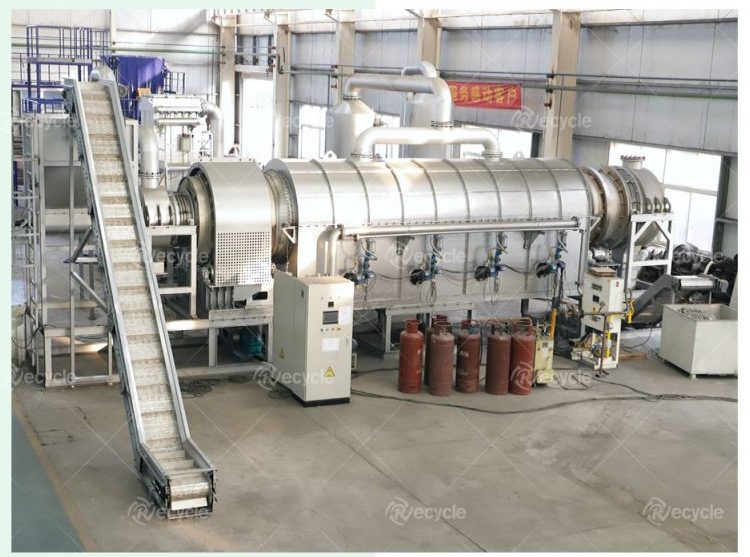
A continuous carbonization furnace completely changes the workflow. Instead of treating carbonization as a series of separate batches, the equipment creates an uninterrupted production process. Biomass enters the system steadily, moves through controlled heating zones, and leaves as finished biochar without repeated shutdowns. More importantly, the furnace maintains a stable thermal environment, ensuring that each portion of the material remains under similar processing conditions.
From our engineering experience, temperature stability is often more valuable than simply reaching a high temperature. Excessive heat can reduce the quality of biochar, while insufficient heating leaves uncarbonized material inside the final product. Continuous production allows operators to maintain a more balanced process, making product quality easier to predict over long production periods.
Raw material selection also deserves more attention than many investors expect. Biomass is not a uniform resource. Coconut shells behave differently from bamboo, while rice husks respond differently from wood chips. Moisture content, particle size, fiber structure, and even seasonal changes can influence production efficiency. For this reason, successful carbonization projects rarely rely on equipment alone. They depend on matching the production line to the characteristics of the available feedstock.
One misconception we often hear is that larger equipment automatically generates higher profits. In reality, capacity should always match the raw material supply. A factory processing several tons of biomass every day may benefit greatly from continuous production, but a business with only occasional feedstock may find a smaller solution more practical. Choosing equipment that exceeds actual production needs often increases operating costs without improving profitability.
This is why project planning usually begins with questions rather than quotations. Before recommending a production line, our engineers first evaluate the customer’s biomass type, daily output, moisture level, available energy source, and local environmental requirements. These factors determine not only the equipment configuration but also the long-term operating efficiency of the entire project.
At Henan Recycle Environmental Protection Equipment Co., Ltd., our continuous carbonization furnace is designed as part of a complete biomass recycling solution rather than a standalone machine. Depending on project requirements, the system can be integrated with crushing equipment, drying units, automatic feeding conveyors, gas purification devices, cooling systems, and intelligent control cabinets. This modular approach enables customers to process a wide range of biomass materials while maintaining stable operation and reducing unnecessary energy consumption.
We also understand that every project develops over time. Some customers begin with agricultural waste, while others later expand into forestry residues or biomass from food processing industries. For this reason, flexibility is an important consideration during equipment design. A production line that can adapt to changing raw materials often provides greater long-term value than one optimized for only a single feedstock.
The global biochar market continues to evolve as more industries seek practical ways to recycle biomass waste and reduce carbon emissions. Yet technology alone does not guarantee success. Consistent product quality, efficient resource utilization, and equipment matched to real production conditions remain the factors that separate profitable projects from those that struggle.
For companies planning to transform biomass waste into commercial biochar, investing in a continuous carbonization furnace is not simply purchasing another machine. It is choosing a production strategy designed for stable operation, scalable growth, and more efficient resource recovery.