
How Many Steps Does It Take to Recycle Solar Panels in a Modern Automated Plant?
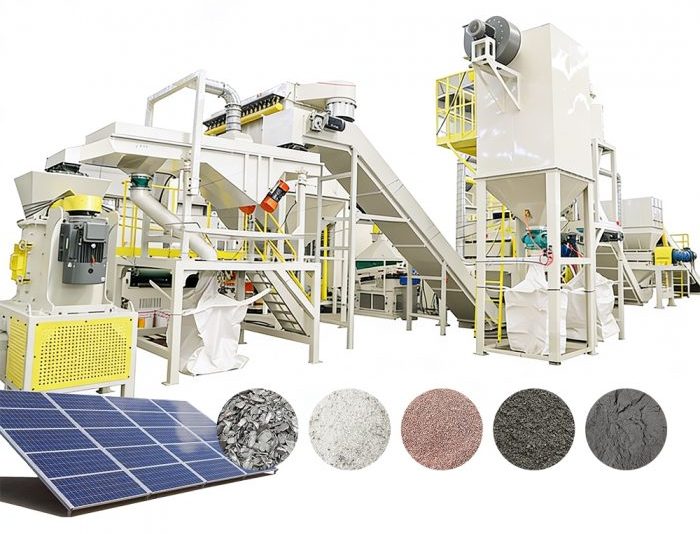
Instead of simply reducing waste volume, automated solar panel recycle plants aim to maximize material recovery, stabilize production, reduce labor dependency, and improve environmental performance simultaneously.
This requires more specialized stages.
The process usually starts with automated feeding systems that transport panels continuously into the dismantling area. Stable feeding reduces interruptions and improves production rhythm.
The next stage is intelligent dismantling.
Automated frame removal systems separate aluminum efficiently while minimizing damage to reusable fractions. Some advanced plants also integrate automatic junction box cutting systems to improve copper recovery.
The third stage is delamination pretreatment.
Modern plants increasingly use thermal systems to soften or decompose EVA bonding layers before crushing begins. This step significantly improves downstream liberation.
The fourth stage is primary crushing.
Unlike traditional aggressive shredding, modern systems use controlled reduction designed specifically for photovoltaic materials. This reduces contamination and improves sorting precision later.
The fifth stage is fine crushing and particle optimization.
Different downstream sorting technologies require specific particle sizes. Multi-stage crushing improves separation performance significantly.
The sixth stage is automated sorting.
Magnetic systems recover ferrous fractions.
Eddy current systems recover non-ferrous metals.
Airflow systems remove light impurities.
Screening systems classify particles by size.
Some advanced plants also integrate optical sorting technologies for enhanced recovery precision.
The seventh stage is dust and environmental control.
Modern automated plants often include centralized dust collection systems, enclosed conveyors, and negative-pressure extraction systems to reduce pollution and improve workshop safety.
The final stage is material packaging and collection.
Recovered aluminum, glass, copper, and silicon fractions are separated and prepared for resale or secondary refining.