
Solving Plastic Contamination in Thin Hair Wire and Auto Harness Recycling
Processing thick industrial power cables on a copper wire granulator is straightforward, but mixed household wires, ultra-thin hair wires (under 0.2 mm), and automotive wiring harnesses present a notorious headache: plastic contamination in the finished copper granules. Even 1% to 2% residual PVC or cross-linked polyethylene (XLPE) significantly reduces scrap resale prices. Fortunately, most plastic carryover stems from improper machine tuning rather than equipment failure.
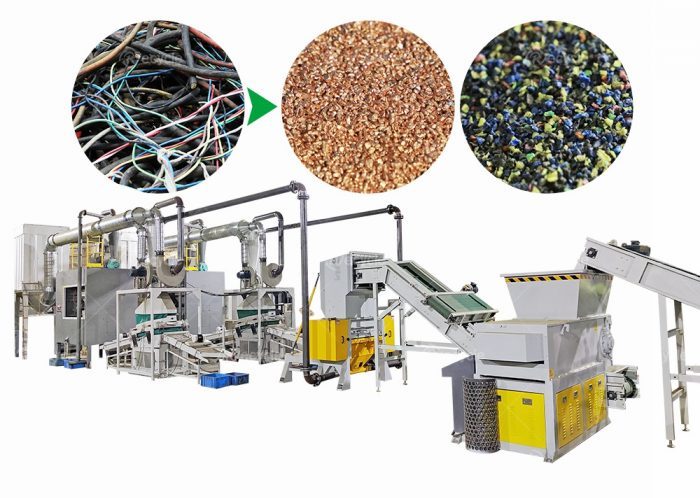
Root Causes of Plastic Carryover in Fine & Auto Wires
-
Incomplete Stripping in the Crusher: Thin strands bend rather than shear when blade gaps are too wide, leaving tiny plastic sleeves wrapped around individual copper filaments.
-
Excessive Air Table Suction or Vibration: Automotive harnesses contain sticky PVC tape, foam wrapping, and rigid nylon connectors. If airflow is poorly balanced, heavy plastic chips ride upward with the copper stream instead of floating toward the tailings discharge.
-
Oversized Screen Mesh: Using a large crusher screen (e.g., 5 mm or 6 mm) allows unstripped hair-wire tangles to pass straight onto the air gravity separator before the copper and insulation are fully liberated.
Step-by-Step Machine Tuning Guide for 99.9% Copper Purity
Follow these four mechanical adjustments whenever switching from thick cables to thin hair wires or automotive harnesses:
-
Step 1: Tighten Crusher Blade Clearance to 0.15 mm – 0.20 mm. Sharpen both rotary and stationary D2 tool steel blades, then narrow the cutting gap. Tight clearance ensures thin hair wires are cleanly sheared into short 2–3 mm segments rather than folded inside plastic insulation.
-
Step 2: Swap to a 3 mm or 4 mm Crusher Screen. Installing a smaller perforated screen forces mixed auto harnesses to stay inside the granulating chamber slightly longer, guaranteeing complete detachment between copper strands, PVC jackets, and fabric tape before discharge.
-
Step 3: Balance Air Gravity Table Frequency and Fan Damper. Lower the bottom air blower frequency slightly so lightweight PVC and foam particles fluidize gently on top of the copper bed without blowing heavy nylon bits over the copper weir. Increase the vibrating deck angle by 1 to 2 degrees to help clean copper granules climb uphill smoothly.
-
Step 4: Add a Secondary Electrostatic Separator for Ultra-Fine Dust. For hair wires under 0.15 mm, route the light plastic tailings through a compact electrostatic separator to capture micro-copper dust that is too light for gravity separation.
Preventive Maintenance to Keep Separation Stable
-
Clean the Vibrating Screen Deck Daily: Sticky adhesive from automotive harness tape can clog the air-table mesh holes, creating dead zones where plastic settles into the copper lane. Blow down the deck with compressed air every shift.
-
Monitor Crusher Chamber Temperature: Excessive friction softens PVC insulation, making it smear onto copper granules. Ensure cooling air vents are unobstructed and avoid overfeeding damp wires.
Frequently Asked Questions (FAQ)
Why does automotive wiring harness tape cause clumping in a copper granulator?
Automotive harnesses are wrapped in cloth or PVC electrical tape coated with pressure-sensitive adhesive. Heat generated during high-speed crushing softens this adhesive, causing fine copper and plastic dust to clump together. Running sharp blades with a 3.5 mm screen and strong dust-collector suction minimizes heat buildup and removes sticky lint immediately.
What copper purity should I expect when processing mixed household and auto wires?
With properly sharpened blades (0.15 mm gap), a 3–4 mm screen, and a calibrated air gravity separator, a quality dry copper wire granulator consistently achieves 99.5% to 99.9% copper purity.