
Understanding the Real Recycling Process Behind Modern PV Waste
Millions of photovoltaic panels installed during the early solar boom are approaching retirement age, and recycling them is no longer optional. The challenge is that solar panels are not simple products. They are tightly bonded structures made from glass, aluminum, silicon, EVA film, copper, and other materials layered together for durability.
That durability is excellent for energy production—but difficult for recycling.
So how can solar panels actually be recycled efficiently?
A modern solar panel recycling line is designed not only to break panels apart, but to separate valuable materials while minimizing contamination and material loss.
The process usually begins with frame removal: advanced dismantling equipment quickly removes these frames without damaging the internal structure, significantly reducing labor requirements.
Next comes junction box separation: Modern recycling systems automate this stage, improving throughput while reducing operator risk.
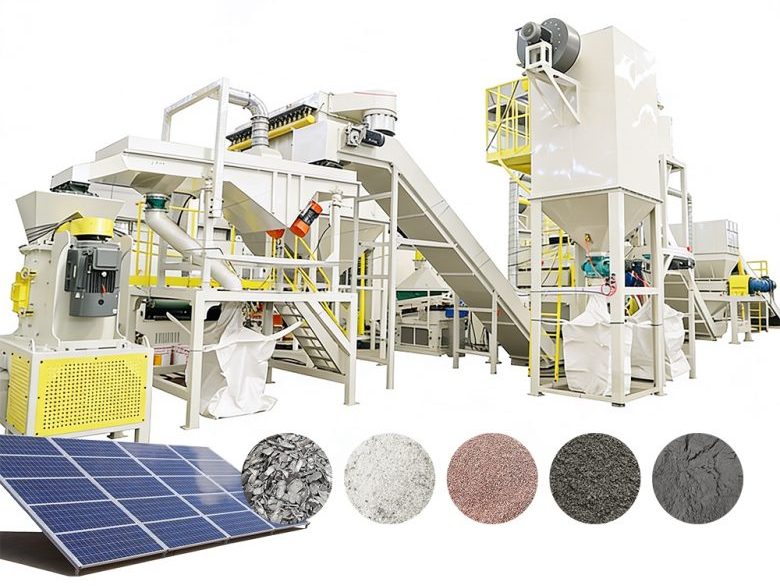
After preliminary dismantling, the panel enters the crushing and delamination stage: Solar panels are laminated with EVA film, which strongly bonds the glass and internal cells. Simple crushing alone cannot achieve clean separation. High-performance recycling systems use controlled thermal treatment or advanced mechanical delamination to weaken the bond before material reduction.
After size reduction, sorting systems begin separating valuable fractions.
Magnetic separators remove ferrous metals.
Airflow systems separate lightweight impurities.
Screening equipment classifies materials by particle size.
Advanced separation systems recover copper, silicon, and non-ferrous metals more efficiently.
The quality of these stages determines overall profitability.
Environmental control is another major advantage of our solar panels recycling equipment.
Dust collection systems, enclosed conveyors, and negative-pressure extraction help reduce secondary pollution inside the workshop. This not only improves environmental compliance but also creates safer working conditions.