
How Modern PV Waste Is Processed
As solar photovoltaic installations continue to expand worldwide, the number of retired and damaged solar panels is also increasing. Panels that have reached the end of their service life cannot simply be treated as ordinary solid waste. They contain glass, aluminum, silicon, copper, polymers and other recoverable materials.
A solar panel recycling machine provides a mechanical solution for separating these materials and preparing them for further reuse or processing.
Why Solar Panels Need Specialized Recycling Equipment
A photovoltaic module is more complicated than it appears from the outside. A typical crystalline silicon panel consists of a glass layer, encapsulation material, solar cells, a backsheet, an aluminum frame and electrical components.These materials are bonded together during manufacturing. As a result, simply dismantling the frame does not completely recycle the panel.A professional solar panel recycling system is designed to reduce the module size and separate valuable fractions. Depending on the plant configuration, the recovered materials can include aluminum, glass, copper and silicon-containing fractions.The main objective is not simply to destroy the panel. It is to transform a difficult waste stream into several usable material streams.
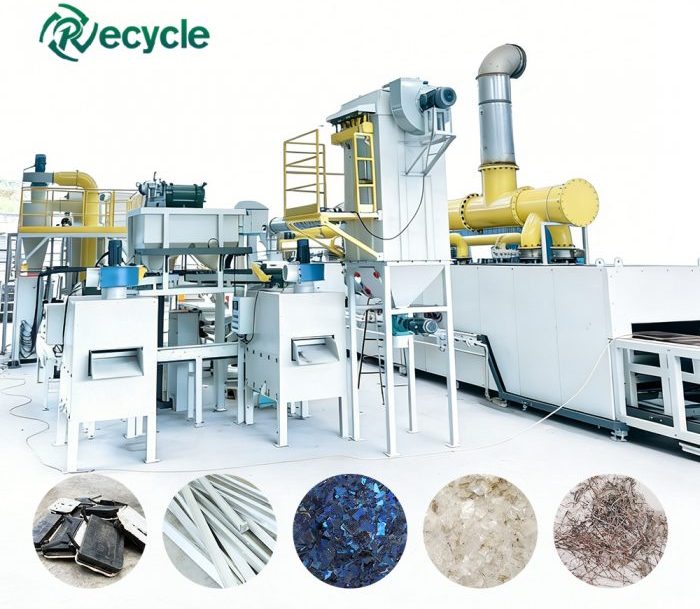
How a Solar Panel Recycling Machine Works
A typical recycling process starts with manual inspection and dismantling. Aluminum frames and junction boxes may be removed before the main mechanical treatment.
The remaining module is then introduced into crushing or size-reduction equipment. The machine breaks the laminated structure into smaller particles while controlling the material size.
After crushing, separation equipment can be used to classify the different fractions. Screens separate materials according to particle size, while magnetic separation can remove ferrous contaminants when necessary.
Air separation, eddy current separation or other technologies may also be incorporated depending on the desired recovery rate and final product quality.
The complete configuration therefore depends on the composition of the incoming panels and the quality requirements for recovered materials.
What Materials Can Be Recovered?
Glass generally represents one of the largest material fractions in crystalline silicon photovoltaic modules. Aluminum from the frame is another valuable material because it can be collected separately during dismantling.Copper may be recovered from cables and electrical components, while the remaining fine fraction can contain silicon, cell fragments and other materials.The exact recovery results depend on the panel design, machine configuration and processing conditions.