
Motor Stator and Rotor Recycling Line
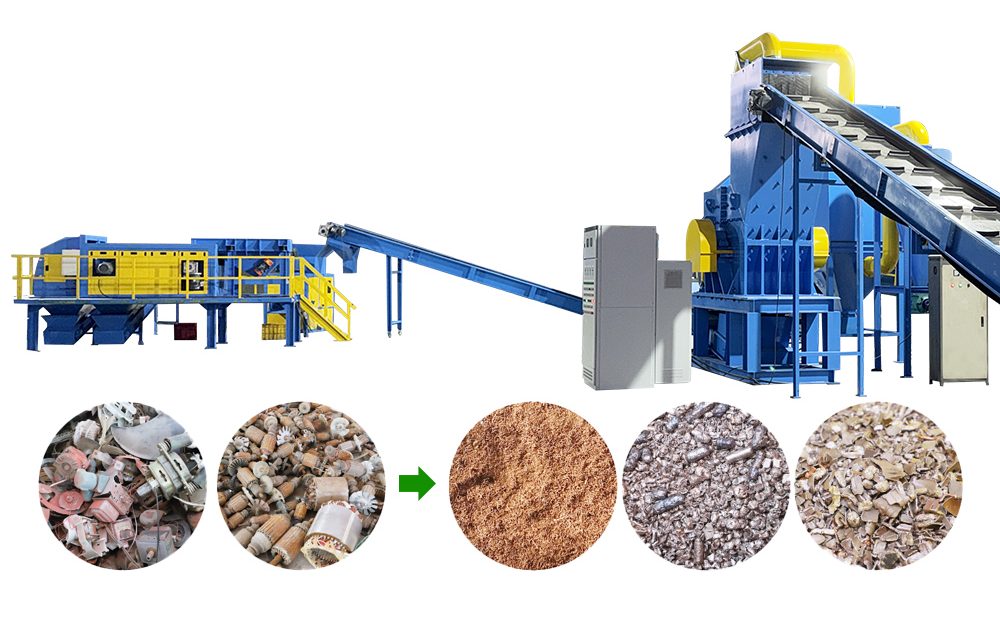
Waste electric motors contain several valuable material streams, including copper, steel, aluminum and other recyclable components. However, these materials are tightly assembled inside motor housings, stators and rotors, making manual dismantling slow when processing large quantities. A motor stator and rotor recycling line provides a continuous way to reduce the size of scrap motors and separate the main metal fractions for further recycling.
What Materials Can the Recycling Line Process?
A motor recycling system can be designed for different sources of scrap, including discarded industrial motors, household appliance motors, electric tools, alternators, stators, rotors and selected transformer components. The exact equipment configuration depends on the motor size, material composition and required capacity.
For recyclers, the main objective is not simply to crush the motor. The more important task is to liberate copper and other valuable materials from ferrous components and then separate them into usable output streams.
How Does a Motor Stator and Rotor Recycling Line Work?
A typical system starts with feeding and primary size reduction. Scrap stators and rotors enter a crusher or hammer mill, where mechanical force breaks the assemblies into smaller pieces and exposes the internal materials.
After primary crushing, magnetic separation removes ferrous material such as steel and iron. In a multi-stage system, additional crushing can be used to improve liberation before another separation stage.
The non-ferrous fraction can then be processed through air separation, eddy current separation or other sorting equipment according to the material characteristics. This allows the line to produce separate copper, aluminum, iron and other fractions rather than one mixed scrap stream. Industry recycling lines commonly combine crushing with multiple separation stages for this reason.
Why Use a Complete Recycling Line?
The biggest advantage of a complete line is process continuity. Instead of manually dismantling each motor, operators can feed batches of scrap into a connected system. Conveyors transfer material between crushing and separation equipment, while the control system coordinates the production flow.
This approach is particularly useful for scrap yards and recycling companies that handle consistent volumes every day. It can reduce dependence on manual sorting and provide more consistent material output.
Another important advantage is flexibility. A recycling line does not have to use exactly the same configuration for every project. Smaller motor components may require a different crushing and separation arrangement than large industrial motors. Some projects may also use pre-treatment or manual sorting before the main line.
Choosing the Right Motor Recycling Line
Before selecting equipment, recyclers should consider several factors:
- Motor and rotor diameter
- Type and composition of incoming scrap
- Required processing capacity
- Target copper and aluminum recovery
- Desired output particle size
- Available installation space
- Dust collection requirements
- Degree of automation
For example, a line processing relatively small stators may use a compact crushing and separation system, while a high-volume recycling facility may require multiple crushing and magnetic separation stages.