
How Advanced Lines Separate Automotive Wire and Mixed Cables
Automotive wiring harnesses, computer patch cords, and telecommunication cables represent some of the most common yet difficult materials in the scrap stream. Unlike standard construction cables, which feature thick, solid copper cores, complex automotive and electronics scrap contains:
Tightly bundled multi-strand cables with greasy protective sleeves.
Iron connectors, plugs, and clips.
Hair-thin copper conductors prone to being blown into the plastic waste stream.
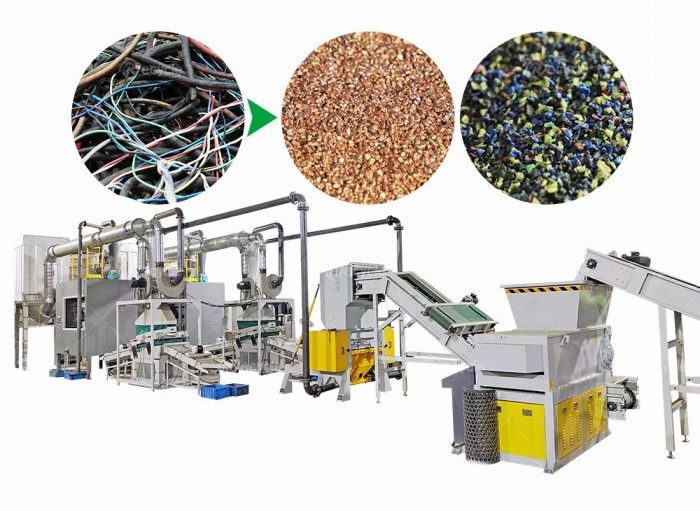
The Multi-Stage Breaking and Separation Strategy
Processing mixed, tangled wire without jamming or metal loss requires a specialized, multi-stage processing setup:
Pre-Shredding with Dual-Shaft Shredders: Heavy bundles are coarsely cut into 30–50 mm segments without winding around the rotor shafts.
Magnetic Separation: Inline neodymium overband magnets extract iron terminals, screws, and clips to protect downstream precision cutting blades.
Fine Granulation & Milling: High-speed rotor knives shear the wire cleanly into uniform 2–4 mm lengths, releasing the copper strands from their sticky insulation.
Air Density + Electrostatic Polishing: While airflow handles the majority of the material, an electrostatic separator charges the remaining micro-fine copper dust and plastic tails. The electrostatic field separates them by electrical conductivity, recovering ultra-thin copper down to 0.02 mm.
This specialized process allows recyclers to process low-cost, mixed automotive scrap and convert it into high-purity copper granules with recovery rates approaching 99.5%.