
Dry Type vs. Wet Type Copper Wire Granulator
Investing in an industrial Copper Wire Granulator Machine enables scrap metal processors to turn mixed 0.2–20 mm waste cables into bright, high-grade copper rice and clean PVC granules with zero wastewater pollution.
Why Wet Table Processing Fails Modern Scrap Yard Compliance?
Operating traditional wet-type shaking table copper granulators or outdated single-stage choppers creates major operational bottlenecks and profit erosion:
- Copper Oxidation and Lower Scrap Resale Price: Wet gravity separation soaks bright copper granules in water, causing surface oxidation and darkening unless expensive thermal drying ovens are run continuously—lowering mill buyback grades.
- Strict Wastewater Discharge & Sludge Penalties: Wet tables consume tons of water daily and generate micro-plastic PVC slurry, triggering costly EPA and EU environmental compliance fines without a closed-loop water treatment plant.
- High Fine Copper Loss in Single-Stage Dry Choppers: Basic dry granulators that lack high-voltage electrostatic sorting lose 3% to 5% of ultra-fine capillary copper strands (<0.3 mm) into the plastic tailing pile.
📐 Need a Custom Copper Wire Recycling Plant Layout?
Not sure whether a dry electrostatic line or hybrid setup fits your workshop? Send us your factory dimensions and target capacity. Our engineers will design a free 2D/3D CAD plant layout within 24 hours. Request Free 3D Layout & Catalog →
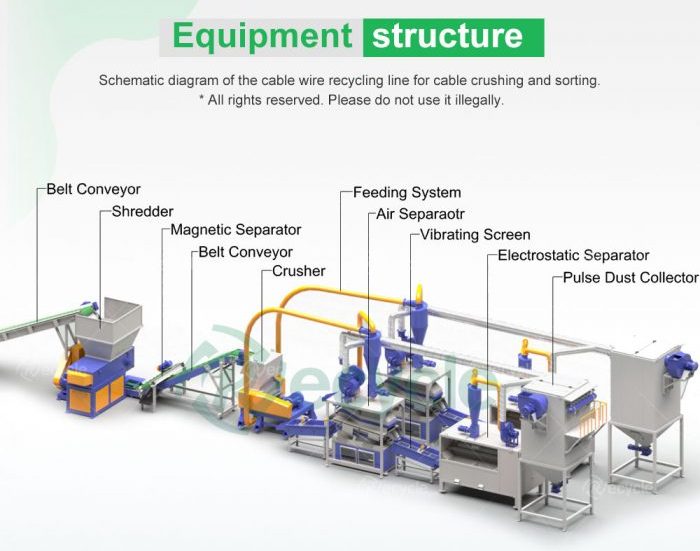
How Does a Turnkey Dry Copper Wire Granulator Line Work?
A complete dry-type Waste Wire Recycling Line combines six automated shredding, fine granulating, airflow gravity, and electrostatic separation stages to outperform wet systems without a single drop of water:
1. Pre-Shredding for Tangled Cables and Car Harnesses
Heavy-duty single-shaft or double-shaft pre-shredders tear tangled bundles of automotive wiring harnesses, household electrical wires, and industrial cables into uniform 50–100 mm segments, ensuring steady, jam-free feeding into the main granulator.
2. Magnetic Separation for Iron Clips and Steel Armor
Overband permanent magnetic belts and magnetic drums positioned after pre-shredding automatically extract iron terminals, steel armor strands, and ferrous clips, protecting the high-speed granulator blades from impact damage.
3. High-Speed Shear Crushing and Copper Liberation
A heavy-duty rotary knife granulator equipped with alternating rotating and stationary SKD11 blades shears wire segments into 1–5 mm particles. Water-cooled crushing chambers prevent PVC insulation from melting and sticking to copper strands.
4. Air Gravity Separation for Primary Copper Recovery
An adjustable airflow specific-gravity separator uses dual air currents and eccentric deck vibration to suspend lighter PVC/PE insulation while moving heavy copper granules upward, separating over 97% of clean copper rice in a single pass.
5. High-Voltage Electrostatic Separation for Hair Wires
To eliminate the need for wet shaking tables on thin communication and headphone wires, the plastic tailings pass through a closed-loop electrostatic separator. High-voltage corona charges extract ultra-fine 0.1–0.3 mm copper hairs from plastic granules, pushing overall recovery purity to 99.5%.
6. Pulse-Jet Dust Collection System
All shredding, granulating, and air sorting nodes operate under negative pressure connected to a cyclone and pulse-jet baghouse dust collector, capturing fine insulation dust and talcum powder to keep your scrap yard clean and OSHA-compliant.
⚙️ Want to See Real Bright Copper Rice Separation Purity?
Contact us to get unedited factory trial run videos processing sticky car harnesses and ultra-fine hair wires—or ship your scrap cable samples to our factory for a live video test!
How to Choose Between Dry and Wet Copper Wire Granulators?
Selecting wire granulation equipment should start with your cable diameter and local environmental rules rather than machine price alone:
- Identify Raw Material Composition: Standard building wires, Ethernet cables, and automotive harnesses (0.2–20 mm) achieve 99.5% purity on a dry airflow + electrostatic line; wet shaking tables are only needed if processing heavily oil-soaked or radiator-sludge-mixed wires.
- Determine Required Processing Capacity: Match hourly throughput (100–200 kg/h compact RSKCR-200 vs. 800–1000 kg/h RSKCR-1000) with your daily scrap intake and labor budget.
- Evaluate Workshop Space & Environmental Standards: Dry copper granulators require zero water supply or drainage permits and preserve bright #1 copper color for maximum resale value.
Frequently Asked Questions (FAQ)
Can a dry copper wire granulator process sticky automotive wiring harnesses and plugs?
Yes. By integrating a double-shaft pre-shredder, magnetic separator, and talcum powder dosing feeder before the main granulator, sticky tape on car harnesses is coated and prevented from gumming up the crusher blades or air table mesh.
How long do the granulator blades last before sharpening?
Our copper wire granulators use vacuum heat-treated SKD11 or D2 alloy steel blades. Under normal operation with pre-magnetic iron removal, blades run 300 to 500 hours before routine sharpening and can be re-ground 8 to 10 times, lasting 2,500 to 3,500 total working hours.
What is the delivery time and installation support for overseas buyers?
Standard manufacturing lead time is 20 to 35 working days, followed by a complete Factory Acceptance Test (FAT) using real scrap copper cables. Henan Recycle provides complete 3D foundation drawings, English PLC interfaces, and dispatches engineers to your site for installation and commissioning.
Looking for a profitable scrap wire recycling solution? Leave a message below with your 1) Raw material photos, 2) Target capacity (kg/h), and 3) Local industrial voltage. Contact Henan Recycle today to get a tailored configuration list and FOB/CIF quotation within 24 hours!