
Complete Guide to Solar Panel Recycling Machine
Achieving over 99% recovery of aluminum frames, low-iron tempered glass, copper ribbons, and high-purity silicon powder in commercial solar panel recycling requires an integrated deframing, thermal/mechanical delamination, and electrostatic separation system. End-of-life photovoltaic (PV) modules feature multi-layer structures laminated with stubborn ethylene-vinyl acetate (EVA) encapsulants. Investing in an automated Solar Panel Recycling Machine enables recycling facilities to cleanly strip aluminum frames, remove 98% of intact glass granules, and separate silver-bearing silicon powder from backsheet plastics without chemical acid leaching.
Why Traditional Processing Fails in End-of-Life PV Module Recovery?
Crushing whole discarded solar panels directly in standard hammer mills without prior delamination causes severe material cross-contamination and revenue loss:
- Glass Contamination with EVA and Silicon: Direct shredding embeds fine glass shards into sticky EVA film and silicon wafers, turning high-value low-iron solar glass into worthless landfill cullet.
- Unrecovered Silver and Copper Ribbons: Without precision fine grinding and high-voltage electrostatic sorting, tin-coated copper busbars and trace silver paste remain trapped inside polymerized backsheet residues.
- Fluorinated Backsheet Dust & Safety Risks: Open-loop crushing of Tedlar (PVF/PVDF) backsheets releases hazardous fluorinated dust and fine silica particles into the workshop, failing EU WEEE and OSHA environmental audits.
📐 Need a Custom Solar Panel Recycling Plant Layout?
Not sure if your workshop fits a turnkey PV module recycling line? Send us your factory dimensions and target capacity. Our engineers will design a free 2D/3D CAD plant layout within 24 hours. Request Free 3D Layout & Catalog →
How Does a Turnkey Solar Panel Recycling Plant Work?
A complete Solar Panel Recycling Plant combines six automated mechanical dismantling, EVA delamination, and dry separation stages to maximize resource recovery:
1. Automated Aluminum Frame & Junction Box Dismantling
Hydraulic PLC-controlled deframing machines automatically clamp panels of varying dimensions, prying off the four aluminum alloy frame edges and shearing off the polymer junction box and cables in under 25 seconds per panel with 100% aluminum recovery.
2. Precision Heated-Roller Glass Delamination
Deframed PV laminates pass through an infrared pre-heating tunnel that softens the EVA adhesive layer before entering specialized wear-resistant milling rollers. Over 98% of the low-iron tempered glass is cleanly stripped off as uniform 1–5 mm granules without shattering the underlying silicon cells.
3. Multi-Stage Shredding and Fine Crushing
The remaining silicon wafer, EVA film, copper ribbon, and backsheet laminate is fed into a heavy-duty double-shaft shredder followed by a high-speed turbine crusher, reducing the composite sheets into millimeter-sized flakes to liberate embedded metals.
4. Vibrating Rotary Screening and Silicon Powder Extraction
Multi-deck high-frequency vibrating screens classify the crushed mixture by particle size. Brittle monocrystalline and polycrystalline silicon fractures into fine powder that passes through the bottom mesh, separating immediately from coarser plastic and metal flakes.
5. Air Gravity Separation for Copper & Backsheet Plastic
Specific gravity air classifiers utilize controlled upward airflow and deck vibration to separate dense tinned-copper ribbons from lightweight EVA and PET/PVF backsheet plastics, achieving over 99% copper recovery purity.
6. Electrostatic Separation & Pulse-Jet Dust Collection
A high-voltage corona electrostatic separator purifies the fine fraction by separating conductive silver/copper particles from non-conductive silicon and plastic dust. Meanwhile, a centralized pulse-jet baghouse system captures all airborne silica dust under negative pressure.
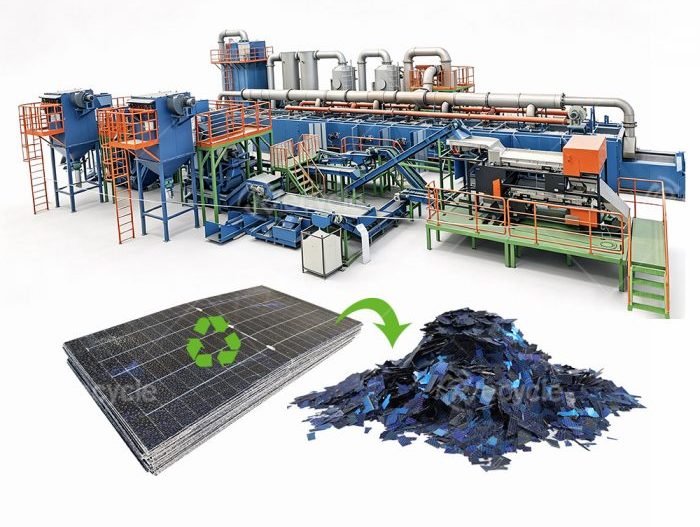
⚙️ Want to See Real Glass, Silicon & Copper Separation Purity?
Contact us for unedited factory trial-run videos of mono-facial and double-glass solar panels—or ship your discarded PV modules to our factory for a live video test!
How to Choose the Right Solar Panel Recycling Equipment?
Selecting a PV module recycling line should start with your panel types rather than the machine model alone:
- Identify Raw Material Composition: Standard single-glass backsheet modules and bifacial double-glass solar panels require different glass milling roller clearances and crushing screen meshes to prevent EVA jamming.
- Determine Required Processing Capacity: Match hourly throughput (300 kg/h ~12 panels/h vs. 1000–2000 kg/h ~40–80 panels/h) with your solar farm decommissioning contracts and local electricity tariff.
- Evaluate workshop space and environmental standards: Ensure your facility can accommodate the automated panel-loading conveyor, deframing station, crushing/sorting line, and centralized baghouse dust collector.
Frequently Asked Questions (FAQ)
Can one solar panel recycling line process both single-glass and double-glass (bifacial) panels?
Yes. Our glass delamination machine features PLC-adjustable roller gap settings and modular infrared heating zones, allowing seamless switching between standard backsheet PV modules and double-glass bifacial panels without changing core rotors.
How long do the glass milling rollers and crusher blades last?
Because solar glass and silicon are highly abrasive, our delamination rollers and fine crusher blades are manufactured from tungsten-carbide-coated alloy and SKD11 tool steel, delivering 2,500 to 3,500 operating hours before routine resurfacing.
What is the delivery time and installation support for overseas buyers?
Standard manufacturing lead time is 30 to 45 working days, followed by a complete Factory Acceptance Test (FAT) using real waste solar panels. Henan Recycle provides complete 3D foundation drawings, English PLC interfaces, and dispatches engineers to your site for installation and commissioning.
Looking for a profitable solar panel recycling solution? Leave a message below with your 1) Raw material photos, 2) Target capacity (kg/h), and 3) Local industrial voltage. Contact Henan Recycle today to get a tailored configuration list and FOB/CIF quotation within 24 hours!