
A Professional PCB Crushing Machine
PCBs are layered composite materials. Copper foil, resin, fiberglass, solder, and electronic coatings react differently under mechanical force. If crushing energy is too weak, metals stay attached to substrate fragments. If crushing becomes too aggressive, fine dust increases, and separation efficiency drops.
Modern systems typically use staged crushing instead of single-pass destruction. Coarse shredding opens the structure first. Secondary crushing then releases metal particles progressively while controlling heat and particle size.
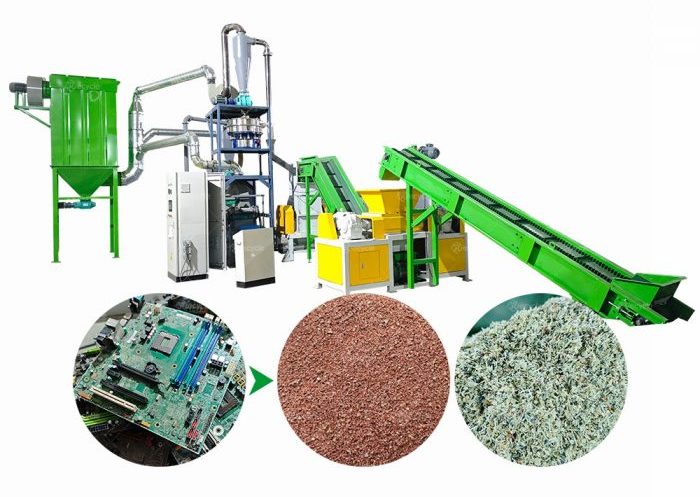
That process stability matters more than many operators realize.
Inconsistent particle size directly affects airflow separation and electrostatic sorting later in the line. Poor liberation reduces copper recovery and increases waste residue.
Another important advantage of advanced PCB crushing equipment is environmental control.
Electronic waste processing generates fine particulate dust that can quickly contaminate workshops and damage equipment. High-quality crushing systems integrate pulse dust collection and negative-pressure airflow to maintain cleaner operation.
As e-waste volumes continue increasing globally, recyclers are discovering that metal recovery efficiency depends less on crushing force and more on crushing precision.
And that distinction is reshaping how modern PCB recycling systems are designed.