
How to Achieve 99% Black Mass Recovery Rate in Lithium-Ion Battery Recycling?
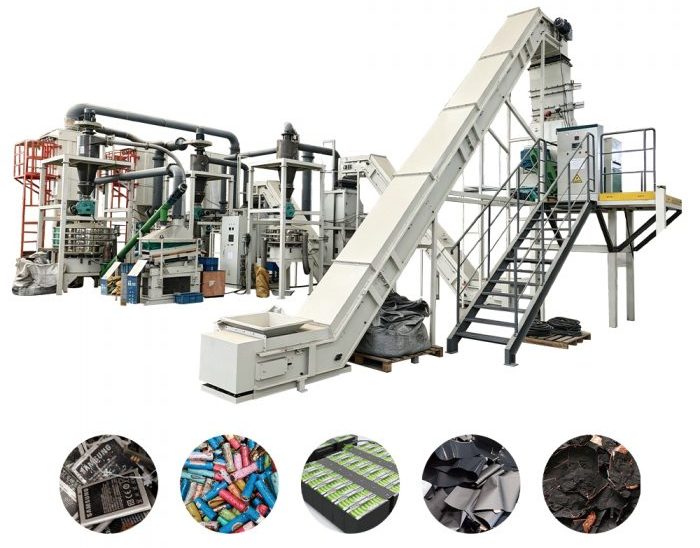
Achieving over 99% black mass recovery rate and copper-aluminum separation purity in spent EV and consumer battery processing requires an oxygen-free mechanical shredding, vacuum pyrolysis, and multi-stage airflow sorting system. Different battery chemistries—such as NCM, LFP, and LCO cells—contain high-value lithium, cobalt, nickel, and graphite tightly bound to aluminum and copper current collectors by PVDF binders. Investing in an industrial Lithium-Ion Battery Recycling Machine enables battery recyclers to safely crush live or discharged cells and extract high-purity black mass without thermal runaway risks or wastewater pollution.
Why Traditional Processing Fails in Lithium Battery Black Mass Recovery?
Handling spent power batteries and battery production scrap with conventional open-air crushers leads to severe black mass loss, metal cross-contamination, and safety hazards:
- Incomplete Binder Decomposition and Low Black Mass Yield: Without controlled thermal pyrolysis to break down organic electrolytes and PVDF binders, up to 18% of valuable cathode and anode powder remains adhered to copper and aluminum foils.
- High Fire and Explosion Risks: Crushing residual-charge soft-pack or prismatic lithium-ion batteries in open oxygen environments triggers short circuits, electrolyte ignition, and violent thermal runaway.
- Toxic Fluoride and Electrolyte Emissions: Unsealed mechanical grinding releases hazardous hydrogen fluoride (HF), volatile organic compounds (VOCs), and fine graphite dust into the workshop, violating strict EU Battery Regulation and EPA standards.
📐 Need a Custom Lithium Battery Recycling Plant Layout?
Not sure if your workshop fits a closed-loop black mass recovery line? Send us your factory dimensions and target capacity. Our engineers will design a free 2D/3D CAD plant layout within 24 hours. Request Free 3D Layout & Catalog →
How Does a Turnkey Lithium-Ion Battery Recycling Plant Work?
A complete Lithium Battery Recycling Plant integrates six automated nitrogen-protected crushing, thermal treatment, and precision sorting stages to maximize black mass purity:
1. Nitrogen-Protected Shredding with Live-Cell Safety
Spent lithium-ion batteries (cylindrical, pouch, or prismatic cells) are fed through an airtight airlock into a heavy-duty double-shaft shredder filled with inert nitrogen gas. Real-time oxygen sensors and temperature monitors prevent sparks and electrolyte combustion while tearing cells into uniform strips.
2. Low-Temperature Vacuum Pyrolysis & Electrolyte Evaporation
Shredded battery materials enter an indirectly heated rotary pyrolysis furnace operating at 400°C–500°C under oxygen-deficient conditions. Organic electrolytes, plastic diaphragms, and PVDF binders are thermally decomposed, completely detaching cathode and anode active powders from metallic foils.
3. Primary Screening and Magnetic Separation
After cooling, a rotary drum screen separates coarse battery casings from liberated black mass powder. Overband magnetic separators immediately extract steel shells and ferrous tabs to prevent downstream equipment wear and iron contamination in the black mass.
4. High-Speed Fine Crushing and Foil Delamination
Specialized hammer pulverizers gently beat and roll the remaining copper and aluminum foils into spherical granules while stripping away any residual electrode coating without over-grinding the malleable metals into fine dust.
5. Air Gravity and Vibration Sorting for Copper & Aluminum
Precision air gravity classifiers and multi-deck vibrating screens exploit density differences between copper (8.96 g/cm³) and aluminum (2.70 g/cm³). This stage delivers clean copper granules, pure aluminum granules, and over 99% pure black mass powder.
6. Exhaust Gas Scrubbing and Pulse-Jet Dust Collection
All pyrolysis off-gases and crushing dust are routed through a secondary combustion chamber (RTO), alkaline spray tower, activated carbon adsorption unit, and pulse-jet baghouse collector, neutralizing fluorides and VOCs to meet strict global emission norms.
⚙️ Want to See Real Black Mass & Foil Separation Purity?
Contact us to get unedited factory trial run videos processing NCM/LFP batteries and gigafactory pole piece scrap—or ship your raw material samples to our factory for a live video test!
How to Choose the Right Lithium-Ion Battery Recycling Equipment?
Selecting a black mass recycling system should start with your battery feedstock rather than the machine model alone:
- Identify Raw Material Composition: Clean gigafactory cathode/anode trimmings (pole pieces) only require dry crushing and air classification, whereas charged EV cells require nitrogen-protected shredding and vacuum pyrolysis.
- Determine Required Processing Capacity: Match hourly throughput (200–300 kg/h vs. 800–1000 kg/h) with your annual battery supply, nitrogen generation setup, and local power tariff.
- Evaluate Workshop Space & Environmental Standards: Ensure the pyrolysis furnace footprint, RTO off-gas treatment tower, and negative-pressure dust collection comply with your local environmental permits.
Frequently Asked Questions (FAQ)
Do lithium-ion batteries need brine discharging before entering the shredder?
No. While traditional plants require slow and polluting saltwater discharging, our closed-loop system shreds charged cells directly under an inert nitrogen atmosphere with oxygen levels maintained below 2%, eliminating short-circuit fires and wastewater treatment costs.
What is the copper and aluminum impurity level in the final black mass?
Through multi-stage vacuum pyrolysis and precision airflow classification, copper and aluminum impurities in the recovered black mass are strictly controlled below 1%, maximizing your downstream hydrometallurgical leaching value.
What is the delivery time and installation support for overseas buyers?
Standard manufacturing lead time is 45 to 60 working days, followed by a complete Factory Acceptance Test (FAT) using real lithium battery scrap. Henan Recycle provides complete 3D foundation drawings, English PLC interfaces, and dispatches engineers to your site for installation and commissioning.
Looking for a profitable lithium battery recycling solution? Leave a message below with your 1) Raw material photos, 2) Target capacity (kg/h), and 3) Local industrial voltage. Contact Henan Recycle today to get a tailored configuration list and FOB/CIF quotation within 24 hours!