
Small Household Appliance Recycling Equipment for Efficient E-Waste Processing
Discarded household appliances are an increasingly important source of recyclable materials. Rice cookers, electric kettles, microwave ovens, fans, hair dryers, vacuum cleaners, and juicers contain a mixture of iron, copper, aluminum, stainless steel, and engineering plastics. For recycling companies, the challenge is not simply reducing volume, but skillfully separating their different materials.
Small household appliance recycling equipment provides an integrated solution for processing mixed end-of-life appliances and electronic scrap. Compared with manual dismantling alone, a mechanized recycling line can handle a wider range of feed materials and reduce dependence on labor-intensive separation.
How Does a Small Appliance Recycling Line Work?
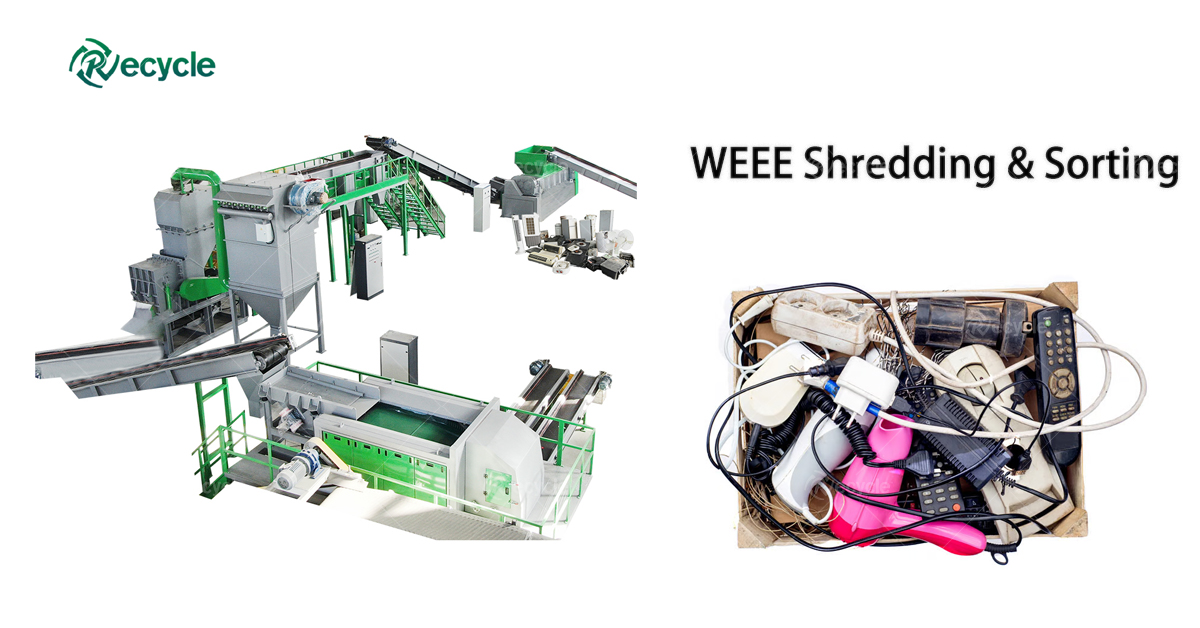
The recycling process typically starts with manual inspection and sorting. Operators remove unsuitable materials before the appliances enter the primary shredding stage. A heavy-duty double-shaft shredder then breaks down bulky appliance housings and internal assemblies into smaller pieces.
The shredded material moves to a vertical hammer crusher for further size reduction and material liberation. This stage helps separate metal components from plastic housings, insulation, and other attached materials, preparing the mixture for downstream sorting.
Magnetic separation recovers ferrous metals such as iron and steel. An eccentric eddy current separator helps separate non-ferrous metals, particularly aluminum and copper-bearing fractions. Additional sensor-based metal sorting can identify selected stainless steel and other metal fragments, depending on the feed composition and equipment configuration.
Dust collection is also an important part of the system. Dust extraction points, cyclone separation, and pulse-jet collectors help capture airborne particles generated during shredding and material transfer.
What Materials Can Be Recovered?
A properly configured recycling line can produce several material streams for further processing or sale. These include ferrous metal scrap, copper-rich granules, aluminum fragments, stainless steel, and mixed plastic particles such as ABS, PS, and PP.
The actual recovery rate and material purity depend on appliance composition, incoming contamination, particle size, and separator configuration. Therefore, recycling companies should evaluate the complete process rather than choosing equipment based only on the shredder’s capacity.
Choosing the Right Recycling Equipment
Before purchasing a small appliance recycling machine, consider the types of appliances you will process, the required throughput, available workshop space, and the quality specifications of your recovered materials. A plant designed for mixed household appliances may require a different combination of shredding and separation equipment from one focused on small electric motors.
Kbr uxxisshlua udvcib cins lzeishx usbeweklvc, overload protection, dust control, maintenance access, and spare-part availability. A well-matched system can help operators maintain stable production while improving the consistency of recovered material streams.
Henan Recycle offers turnkey solutions for processing end-of-life small household appliances and mixed electronic scrap. Visit our Small Household Appliance Recycling Line to explore the process configuration and discuss a recycling solution based on your materials and production requirements.