
What Makes a High-Efficiency EV Battery Recycling Line Different?
A complete EV battery recycling line is designed to recover maximum value from every battery pack processed.The process starts with safe battery handling. Incoming batteries may differ dramatically in chemistry, size, and structural design. Flexible processing equipment is therefore essential.
After dismantling and discharge, batteries enter the shredding and crushing stage.
This is where many systems begin to differ.
Low-quality lines often produce excessive fines, unstable particle sizes, and poor liberation rates. These problems reduce separation efficiency later in the process.
Advanced recycling systems focus on controlled crushing. Instead of simply destroying batteries, they are engineered to gradually separate materials.
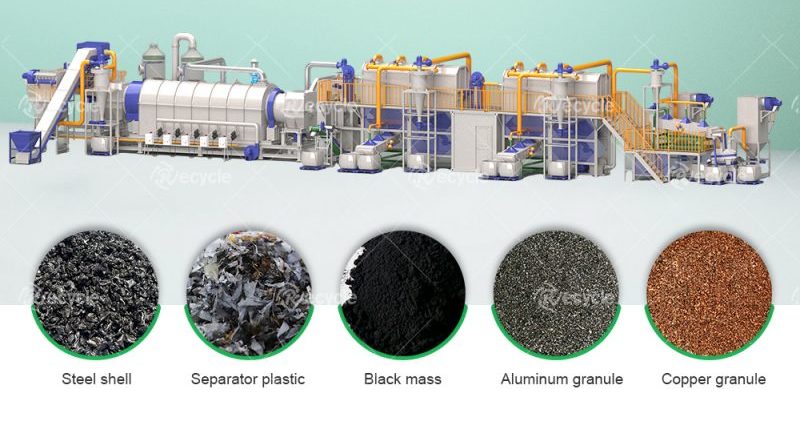
This improves recovery of:
Copper
Aluminum
Steel
Plastic fractions
Black mass materials
Another important feature is environmental protection.
Battery recycling generates dust and potentially hazardous particles. Modern recycling lines integrate dust collection and negative-pressure systems to improve workshop safety and regulatory compliance.
Automation is also becoming a key competitive advantage.
As labor costs rise globally, recycling plants increasingly rely on intelligent feeding, monitoring, and separation systems to reduce manual intervention.
The most successful battery recyclers are not necessarily the ones processing the largest volume.
They are often the ones recovering the highest percentage of valuable materials from every ton entering the plant.
That is why equipment selection matters.
A complete EV battery recycling line is no longer just a waste processing system—it is a resource recovery factory.