
Why Electrostatic Separators Are Essential for High-Purity PV Recycling
In the competitive field of solar panel recycling, achieving high material purity is a key factor in profitability. Electrostatic separators play a crucial role in reaching this goal.
Unlike mechanical or magnetic separation methods, electrostatic technology targets the electrical properties of materials. This enables precise separation of conductive metals from non-conductive components, even at very small particle sizes.
For photovoltaic recycling plants, this capability is particularly valuable. After grinding, valuable materials such as silver traces, copper ribbons, and aluminum fragments are often mixed with glass powder and silicon particles. Traditional methods may struggle to separate these efficiently.
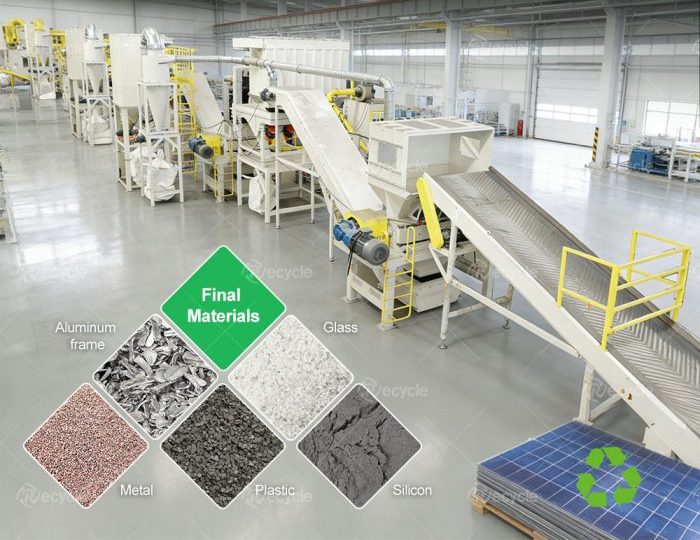
Electrostatic separators address this challenge by creating a high-voltage electric field. Conductive particles quickly discharge and follow a different path compared to insulating materials. This results in clean separation with minimal contamination.
Another advantage is dry processing. Unlike flotation or chemical separation, electrostatic methods do not require water or reagents. This reduces operational complexity and eliminates the need for wastewater treatment systems.
Flexibility is also a strong point. Electrostatic separators can be adjusted to handle different material compositions and particle sizes. This makes them suitable for a wide range of solar panel types, including crystalline silicon and thin-film modules.
Maintenance requirements are relatively low, but proper operation is essential. Feed material must be dry and evenly distributed to ensure consistent results. Advanced systems now include automatic feeding and monitoring to optimize performance.
Overall, electrostatic separators are not just an optional component—they are a necessity for achieving high-efficiency, high-purity solar panel recycling.