
E-Waste Recycling Machine for Small Home Appliances
Overcoming the Extreme Material Diversity of Small Domestic Waste
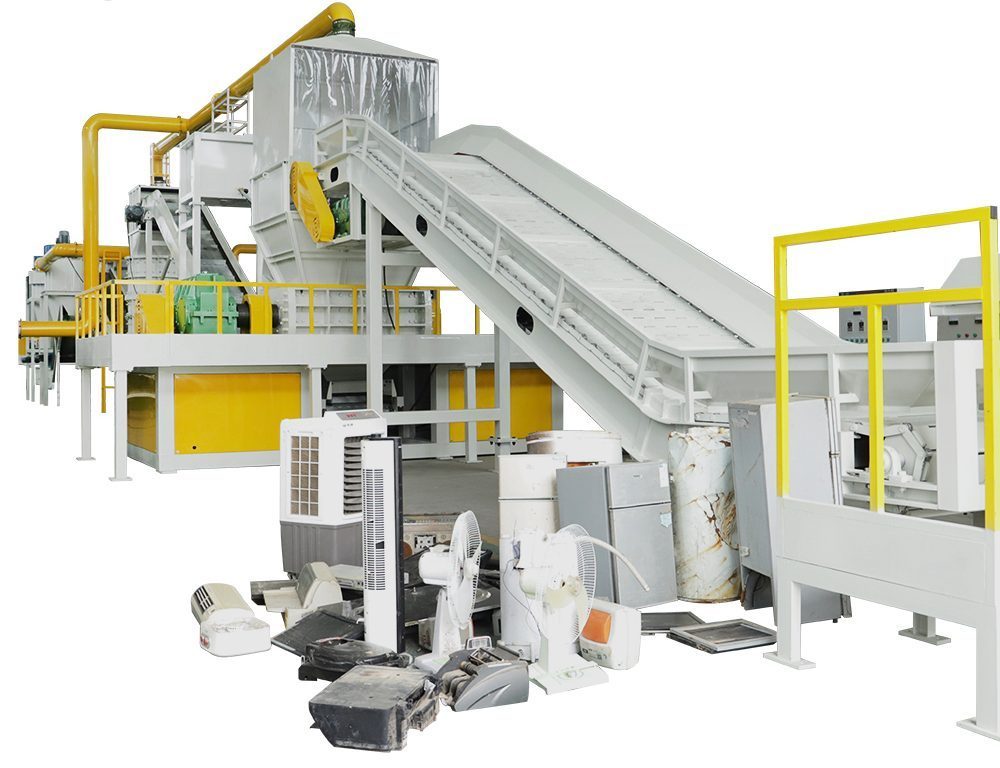
Small home appliances—encompassing toasters, vacuum cleaners, electric kettles, blenders, and power tools—form one of the fastest-growing and most physically frustrating categories of electronic scrap. Unlike electronics composed mainly of thin circuit boards, small appliances consist of heavy ABS and polypropylene shells wrapped around solid iron transformer cores, copper-wound universal electric motors, internal wiring, and structural stainless-steel fasteners. An e-waste recycling machine for small home appliances must apply immense cutting and separating power to unpick this tangled composite stream.
Progressive Separation of Heterogeneous Scrap Streams
A specialized small appliance processing line breaks down complex appliances through a succession of targeted mechanical separations:
- High-Torque Primary Dual-Shaft Shredding: Appliances are dropped whole into a heavy-duty, low-speed dual-shaft shredder. Counter-rotating knife blades, turning at 15 to 25 RPM, slice and crush the mixed plastic-metal assemblies into loose 40–80 mm fragments without generating high heat that would melt domestic casing plastics.
- Neodymium Magnetic Drum Extraction: The shredded mix passes under an overhead cross-belt magnet or over a high-intensity magnetic head pulley. Ferrous materials—including chassis brackets, stator plates, and steel fasteners—are instantly pulled away, yielding clean iron scrap.
- Eddy Current Separation (ECS): The non-ferrous fraction travels along a thin conveyor belt housing a high-speed alternating magnetic rotor spinning at 2,500 to 3,000 RPM. This induces eddy currents within conductive non-ferrous metals, generating an opposing magnetic field that physically throws aluminum heat sinks and copper motor fragments over an adjustable divider splitter, separating them cleanly from the non-metallic residue.
- Air Sorting and Granulation: The residual stream, containing engineering plastics (ABS, PC, PP) and insulated copper cables, enters a high-speed granulator for uniform sizing, followed by a zig-zag air classifier to pull away foam and film, leaving sorted rigid plastics ready for optical or density flotation sorting.
- Mechanical Protection Against Uncrushable Electric Motor Rotors
The electric motors found inside vacuum cleaners and blenders contain thick, solid steel drive shafts. If a shredder blade catches a solid 20 mm shaft at an improper angle, a standard machine risks gearbox tooth stripping. Dedicated appliance shredders prevent this failure through hydraulic pressure sensors integrated into the PLC drive. Upon encountering an unyielding rotor core, the shredder reverses rotation in a fraction of a second, repositions the obstruction, and re-engages from an alternate angle to shear the component safely.